Web applicationSouth AfricaBank APIsFigma
UTD Payments
Payment Automation Platform
An enterprise platform that replaces a manual payment workflow of Telegram, Excel, bank logins and hand reconciliation. Every payment is booked, approved, routed, settled, reconciled and audited with clear ownership.
RoleLead Product Designer, sole designer
AgencyZenlime
ClientConfidential fintech client
Duration3 months
StatusIn development
ToolsFigma
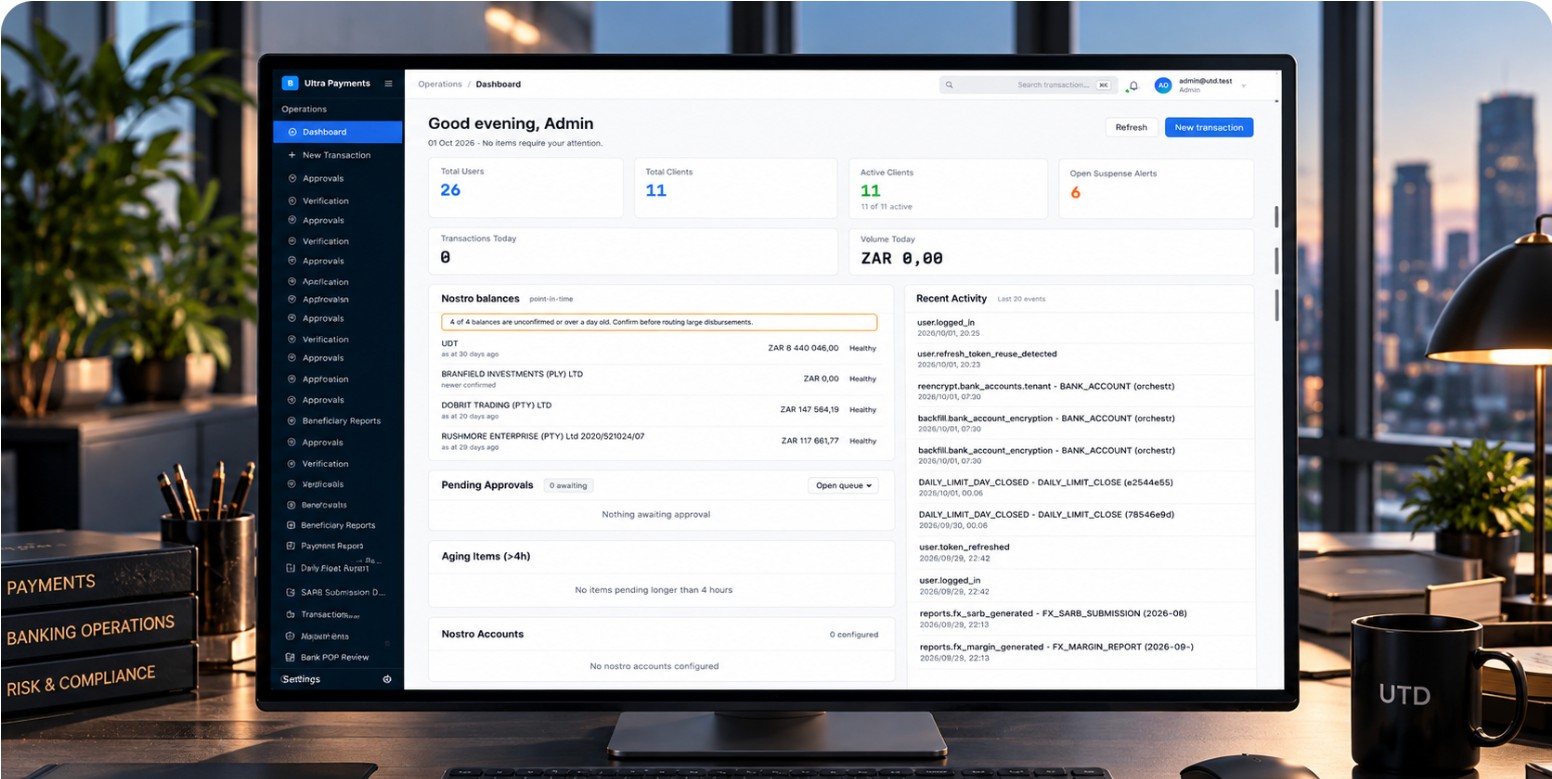
Operations overview, close up
Conceptual UI recreation of the operations overview and transactions table. Synthetic data, not real customer data.
Discovery
A payment used to pass through four disconnected tools.
I researched with the operations team, mapped the manual workflow and its edge cases, and defined role-specific journeys before designing any screen.
Before
Telegram→Excel→Manual bank login→Manual reconciliation
At each handoff, details could be lost, duplicated, delayed or mistyped.
After: one centralized workflow
Booking→Approval→Routing→Settlement tracking→Reconciliation→Audit trail
Human approval stays in charge of financial decisions while the platform automates execution, routing, tracking and record-keeping.
- Approval
- A second team member approves every transaction.
- Scale
- Up to 10,000 transactions per business day, each up to R 5,000,000.00.
- Banks
- Multi-bank operations across South African banks, with routing and fallback.
- Records
- A double-entry ledger and a full audit trail.
- Responsibilities
- Roles with different operational responsibilities, each with its own journey.
Stated requirements describe what the platform must support. They are not results achieved.
EvidencePayments moved through Telegram, Excel and manual bank logins.
InsightEvery handoff was a chance to lose, duplicate, delay or mistype details.
Design responseOne booking, one status model and one history per payment.
EvidenceOperations roles carry different responsibilities.
InsightA shared view gives each person more than they can act on.
Design responseA role-based experience tied to each person’s responsibilities.
EvidenceUp to 10,000 transactions per business day.
InsightScanning a full list cannot surface problems in time.
Design responseException-first operations: failures, mismatches, aging items and connectivity first.
Payment lifecycle
Every payment has one status, and a named owner at each step.
A state-based lifecycle records who acted, what happened, when, and where the payment stands. Settled and Failed are alternative outcomes of Processing, not consecutive steps.
1 · BookingCreatedAn operator books the payment.
2 · ControlPending approvalWaiting for a second team member.
3 · DecisionApprovedThe decision is recorded with name and time.
4 · ExecutionProcessingThe platform routes it to a bank.
5 · One of two outcomes
SettledThe bank outcome is confirmed.
FailedSurfaced as an exception, with retry and fallback planned.
Conceptual UI recreation of transaction detail and status history. Synthetic data.
1Status in the header
The current status is always the first thing on a transaction, in the same colour and wording as in tables and filters.
2Actor and time on every step
Each status change is attributed to a person or to the platform, with a timestamp.
3Outcome stays distinct
Settled and Failed use separate colours and wording, and nothing implies one follows the other.
Booking and approval
Booking is for the person who creates. Approval is for the person who decides.
Two decisions shape these screens: a role-based experience, and dual approval with visible accountability.
Decision A · Role-based workspacesImplementation to be confirmed
Conceptual UI recreation of transaction booking. Synthetic data.
ProblemRoles carry different responsibilities, yet share the same payments.
DecisionEach role sees the screens and actions that match its responsibility.
Trade-offMore screens and states to design and maintain.
Expected impactIntended to cut noise and make the next action obvious. Not yet validated with users.
1Incomplete information is caught early
Missing or invalid fields are flagged beside the field, and submission stays disabled until the booking is complete.
2The approval route is stated up front
The booker sees that a second team member must approve, before submitting.
Business requirementDecision B · Dual approval and accountabilityImplementation to be confirmed
Conceptual UI recreation of payment approval. Synthetic data.
ProblemA payment of up to R 5,000,000.00 needs a decision made with full context.
ConstraintA second team member approves every transaction.
DecisionOne view gathers the context and records the decision against a named person and time.
Trade-offEach payment pauses for a decision. The context sits in one place to keep that pause short.
Expected impactIntended to support accountability and separation of duties. It does not by itself guarantee security or compliance.
1Amount, beneficiary and creator together
The approver sees who created the payment, who it is going to and how much, without opening another page.
2Decision actions and the record
Approve and reject sit in one panel, and the panel states what will be recorded.
3Risk cue for large amounts
A notice prompts a closer check on large payments.
Routing, exceptions and traceability
When something goes wrong, the operator sees what, why and what to do next.
Three decisions make automated behaviour understandable and every movement of money traceable. Implementation status is for engineering to confirm.
Decision C · Routing you can readImplementation to be confirmed
Conceptual UI recreation of routing visibility. Synthetic data. Bank names are generic.
ProblemA payment takes an unexpected route and the operator cannot tell why.
ConstraintRouting is automatic, while people remain accountable.
DecisionShow the criteria behind each choice and the fallback path.
Trade-offMore information to present and keep accurate.
1The decision, in a sentence
The result is written in plain language, so an operator can repeat it to a colleague.
2Criteria side by side
Availability, float, preference, speed and reliability for each bank, in one comparison.
Decision D · Exceptions firstImplementation to be confirmed
Conceptual UI recreation of exceptions and the resolution panel. Synthetic data.
ProblemAt up to 10,000 transactions per business day, a list of everything hides what needs a person.
DecisionLead with failures, mismatches, aging items, connectivity and pending approvals, then open one to see the cause and next action.
Trade-offOverall volume is less prominent on the first screen.
Expected impactIntended to shorten the time between a problem and an operator noticing it. Not yet validated.
1Exception types as the entry point
Counts are grouped by type, so the first screen answers where to look.
2Evidence side by side
For a mismatch, the platform record and the bank statement appear together with the difference called out.
3Next actions in the same panel
Assigning, opening the transaction and adding a note need no navigation.
Business requirementLedger and audit trail
Every movement of money traces to a double-entry ledger, and every action to an audit trail. I designed the two to be read together: the people and statuses on one side, the debits and credits on the other.
Conceptual UI recreation of audit trail and ledger entries. Synthetic data and illustrative account names.
1Audit trail in plain language
Who acted, what happened and when, in order.
2Balanced ledger entries
Debits and credits sit side by side and visibly balance.
Critical interaction states
A payment with no answer from the bank is not a failed payment.
Critical states are designed so an operator never has to guess. This is a design scenario, not a claim that the behaviour is built or tested.
Design scenarioNot presented as implemented or tested
Conceptual UI of a design scenario. Synthetic data.
Operator needs to knowThat the outcome is unknown, for how long, and which bank was used.
Safe actionCheck the bank status. Retrying is blocked, because it could create a duplicate payment.
Information missingThe bank’s final answer. The interface says so plainly.
RecordedWhen the status became unconfirmed, who checked it, and what they did.
1Warning against resubmitting
The banner names the risk in plain words and tells the operator what to do first.
2Investigation is the primary action
Checking the bank status is the one highlighted action.
3Retry disabled, with the reason beside it
The block is explained next to the control, so it is understood and not just encountered.
No exceptionsEverything that needs attention has been resolved.
Empty state
Payment approved.
It is now routing to a bank.
Success feedback
Payment failed.
Bank B returned a rejection. Review the reason before any further action.
Failure with a reason
Outcomes and validation
In development. These are requirements and targets, not results.
No measured outcomes, user-testing results or production data are reported here.
Up to 10,000 transactions per business dayRequirementA stated capacity requirement the platform and design must support.
Transactions of up to R 5,000,000.00RequirementA stated limit that raised the importance of clear approval.
Complete transaction auditabilityRequirementEvery action and movement of money traceable through the audit trail and ledger.
Booking through settlement within 3 minutesDesign targetNot yet measured.
95%+ automated reconciliationDesign targetNot yet measured.
Automatic retry and fallback for failed paymentsPlanned capabilityDesigned behaviour. Delivery depends on the build.
Role-based, exception-first and explainable routing improve operator decisionsUnvalidated hypothesisTo be tested with operators.
Measured outcomesNone yetResults will be added only once they exist.
Validation and next steps
Proposed evaluation metrics, not results.
Payment-processing timeBooking to settlement, against the 3-minute target.
Reconciliation automation rateAgainst the 95% target.
Exception-resolution timeFrom an exception appearing to being resolved.
Duplicate-payment incidentsHow often a payment is sent twice.
Audit-trail completenessWhether every payment has full, attributed history.
- Test
- The core flows with the operations team before release.
- Confirm
- With engineering, which designed behaviours are implemented.
- Baseline
- Agree baselines for the proposed metrics before measuring.
Summary
Complex financial workflows, made understandable to the people who operate them.
Design contribution
As the sole designer, I led research with the operations team, workflow and role-journey mapping, information architecture, UX/UI design and the design system, including the notification and alert system. The platform is in development, and validation with operators is still to come.